 Permis Prêt
All-way stop: who goes first?
The “first come, first served” rule, what it covers and what it leaves out.
Short answer: at an all-way stop, everyone comes to a full stop. Then each driver yields to vehicles that reached the intersection first, and to pedestrians on the road they are about to cross or turn onto. Order of arrival is what counts, not direction.
How to recognize an all-way stop
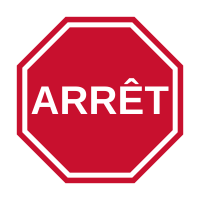
It is a stop sign with a plate underneath saying that drivers from every direction must stop (in French, toutes directions). The plate’s drawing often mirrors the shape of the intersection: a cross, a T or a Y (Guide de la route, ch. 3, “Arrêt”). Without that plate, don’t assume others must stop: at a stop on one road only, the other road has priority.
The rule, step by step
- Full stop. At a stop sign you must bring your vehicle to a stop (Code de la sécurité routière, Quebec’s Highway Safety Code, s. 368), at the stop line if there is one.
- First to arrive, first to go. Where every direction must stop, you yield to any vehicle that reached the intersection before you (s. 370).
- Pedestrians first. You also yield to pedestrians who are crossing, or walking along, the road you are going to cross or turn onto (s. 370). The SAAQ handbook adds cyclists (ch. 4, “Lors d’un arrêt obligatoire”).
- When turning, you also yield to pedestrians and cyclists crossing the street you are turning onto (s. 349).
Running a stop sign, or ignoring the priority it sets, carries 3 demerit points (Regulation respecting demerit points, Schedule, item 20).
| Type of stop | After stopping, you yield to… |
|---|---|
| Stop on your road only | Vehicles on the other road that are entering or too close, plus pedestrians and cyclists (ss. 360, 368, 369) |
| All-way stop | Vehicles that arrived before you, and pedestrians (s. 370) |
| Traffic lights out | Treat it as an all-way stop (s. 367) |
What if two cars arrive at the same time?
The Code does not settle this case explicitly. The general rule of yielding to the vehicle on your right (s. 402) covers intersections where no sign says otherwise, and we found no official text that applies it expressly to all-way stops. In practice, caution means making eye contact, signalling your intention clearly and, when in doubt, letting the other driver go. Nobody ever has the right to force their way through.
Common traps
- The “rolling stop”: slowing down is not stopping.
- Going because the other driver hesitates, even though they arrived first.
- Missing the pedestrian crossing the street you are turning onto.
Key points for the test
- All-way = everyone stops.
- Priority follows the order of arrival at the intersection.
- Pedestrians (and, per the handbook, cyclists): yield to them.
- Traffic lights out = all-way stop.
Original questions with an explanation and a source, “Highway Safety Code” section.
Practise for free
See also
- Roundabout rules in Quebec
- Flashing yellow or red light: what to do
- SAAQ Class 5 knowledge test: how many questions?
Official sources
- Code de la sécurité routière (Highway Safety Code, CQLR c. C-24.2), ss. 349, 360, 367, 368, 369, 370 and 402
- Regulation respecting demerit points (CQLR c. C-24.2, r. 37), Schedule, item 20
- SAAQ, Guide de la route (4th ed., 2024, French), ch. 3, “Arrêt” and “Ligne d’arrêt”; ch. 4, “Lors d’un arrêt obligatoire”
General information page, current as of 2026-10-28. If in doubt, the official text prevails. Rules can change: check saaq.gouv.qc.ca and legisquebec.gouv.qc.ca.