 Permis Prêt
Class 5 knowledge test questions with answers (Quebec, SAAQ): 15 examples
Fifteen example questions (Code, road signs, driving techniques) with the answer and explanation under each one.
Good to know: the SAAQ does not publish its exam questions. These 15 questions are original and checked against the Highway Safety Code and the SAAQ handbooks. To test yourself without seeing the answer, use the free test.
Question 1 · Highway Safety Code
What is the minimum age to obtain a Class 5 (passenger vehicle) learner’s licence in Quebec?
- A 14 years old
- B 16 years old
- C 17 years old
- D 18 years old
Answer
Answer: B — 16 years old
You must be at least 16. The age of 14 applies only to a moped-only licence. Under 18, the SAAQ also requires written consent from a parent or guardian.
Question 2 · Highway Safety Code
What is the minimum time you must hold a Class 5 learner’s licence before you can obtain a probationary licence?
- A 6 months
- B 8 months
- C 12 months
- D 24 months
Answer
Answer: C — 12 months
The minimum learning period is 12 months. You must also have completed the mandatory driving course (theory and practical parts) and passed the SAAQ tests.
Question 3 · Highway Safety Code
Outside the driving course, the person accompanying a learner driver must have held a valid driver’s licence of the appropriate class for at least:
- A 6 months
- B 1 year
- C 2 years
- D 5 years
Answer
Answer: C — 2 years
The accompanying person must have held a valid licence of the right class for at least two years. They sit beside the learner and must be able to help and advise.
Source: Code de la sécurité routière, art. 99 · Guide de la route, ch. 1, « La pratique de la conduite »
Question 4 · Highway Safety Code
During what time of day is a Class 5 learner’s licence holder not allowed to drive?
- A Between 10 p.m. and 5 a.m.
- B Between midnight and 5 a.m.
- C Between midnight and 6 a.m.
- D No hours are restricted if accompanied
Answer
Answer: B — Between midnight and 5 a.m.
A Class 5 learner may not drive between midnight and 5 a.m., even when accompanied.
Question 5 · Highway Safety Code
Your cousin has held her probationary licence for 18 months. Can she accompany you while you practise with your learner’s licence?
- A Yes, if she sits beside you
- B Yes, but only during the day
- C No, a probationary licence holder cannot act as an accompanying driver
- D Yes, if she is 18 or older
Answer
Answer: C — No, a probationary licence holder cannot act as an accompanying driver
The accompanying person must hold a driver’s licence (not a probationary licence) for at least two years. A probationary licence holder is not allowed to accompany a learner.
Question 6 · Road signs and signals
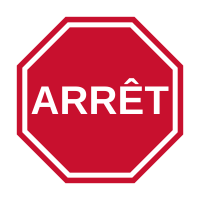
According to the Driver’s Handbook (Guide de la route), which sign is the octagon (8 sides) reserved for?
- A Yield
- B Stop
- C School zone
- D One way
Answer
Answer: B — Stop
The Guide de la route reserves the red octagon for the Stop sign, which requires a complete stop before yielding as needed.
Question 7 · Road signs and signals

What does a downward-pointing red and white triangle sign mean?
- A Mandatory stop
- B Yield
- C Danger: curve
- D End of speed limit
Answer
Answer: B — Yield
This inverted red and white triangle is reserved for the Yield sign: you must let vehicles on the road you are entering go first.
Question 8 · Road signs and signals
You reach a Yield sign and the main road is completely clear. What do you do?
- A You must make a complete stop
- B You proceed without stopping, ready to yield
- C You honk before proceeding
- D You wait for another driver to wave you on
Answer
Answer: B — You proceed without stopping, ready to yield
The Yield sign requires you to give way to vehicles on the other road. If the way is clear, you proceed without stopping; stop only if needed to yield.
Source: Code de la sécurité routière, art. 371 · Guide de la route, ch. 3, « Cédez le passage »
Question 9 · Road signs and signals
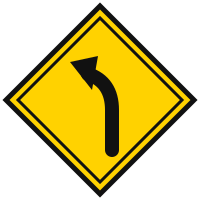
A yellow diamond-shaped sign generally indicates:
- A an obligation
- B a danger or a situation that calls for extra caution
- C a tourist service
- D road work
Answer
Answer: B — a danger or a situation that calls for extra caution
Yellow is the colour of danger (warning) signs, and the diamond is the shape of danger and work-zone signs. Work zones use orange.
Source: Guide de la route, ch. 3, « Formes et couleurs des principaux panneaux »
Question 10 · Road signs and signals
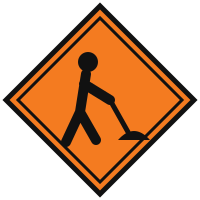
Which colour is reserved for road work signs?
- A Yellow
- B Orange
- C Green
- D Blue
Answer
Answer: B — Orange
Work-zone signs have an orange background. Advance work-zone signs announce a work area ahead: slow down and stay alert.
Question 11 · Driving techniques
What happens to your useful field of vision as your speed increases?
- A It widens
- B It narrows
- C It does not change
- D It widens only at night
Answer
Answer: B — It narrows
The faster you go, the narrower your useful field of vision: you notice less at the sides and have less time to spot hazards. Fatigue, alcohol and drugs have a similar effect.
Question 12 · Driving techniques
Before changing lanes, how do you check your blind spot?
- A By looking only in the inside mirror
- B By quickly turning your head to look over your shoulder, on the side you are moving to
- C By slowing down sharply
- D By honking
Answer
Answer: B — By quickly turning your head to look over your shoulder, on the side you are moving to
Mirrors do not cover everything. A quick glance over your shoulder, without moving your body or changing speed, shows what is in the blind spot.
Source: Conduire un véhicule de promenade, ch. 2, « Les angles morts »
Question 13 · Driving techniques
Even when driving straight, how often is it recommended to check your mirrors?
- A Only before changing lanes
- B Regularly, for example every 10 to 12 seconds
- C Once a minute
- D Only at night
Answer
Answer: B — Regularly, for example every 10 to 12 seconds
Traffic changes quickly. Check your mirrors often (for example every 10 to 12 seconds), and especially before slowing, stopping, turning or changing lanes.
Source: Conduire un véhicule de promenade, ch. 2, « Les rétroviseurs »
Question 14 · Driving techniques
Why should you avoid relying on the right outside mirror to judge the distance of a vehicle behind you?
- A It makes vehicles look farther away than they really are
- B It makes vehicles look closer
- C It reverses left and right
- D Using it is illegal
Answer
Answer: A — It makes vehicles look farther away than they really are
The right mirror makes things behind look farther away than they are. Be careful when using it to judge distance, and also check your blind spot.
Source: Conduire un véhicule de promenade, ch. 2, « Les rétroviseurs »
Question 15 · Driving techniques
What is the right way to take a curve?
- A Brake hard in the middle of the curve
- B Slow down before the curve, keep a steady speed in it and accelerate gradually on the way out
- C Speed up when entering the curve
- D Stay close to the centre line
Answer
Answer: B — Slow down before the curve, keep a steady speed in it and accelerate gradually on the way out
Slow down on the straight, before the curve; look far ahead in the direction of the curve, hold your speed through it and accelerate gradually on the way out. Avoid driving too close to the centre line.
Source: Conduire un véhicule de promenade, ch. 3, « Négocier une courbe »
Practice by section, a 3-section mock exam with the 75% pass mark, and a review of your mistakes. These 15 questions are free in the app; the full version is a one-time CA$12.99.
Practise by section Take the mock exam
Official sources
See also
- Free SAAQ practice test: 15 questions with answers (no sign-up)
- SAAQ Class 1 heavy-vehicle test: 10 free questions with answers
- SAAQ Class 5 knowledge test: how many questions?
Practice questions from an independent product, current as of 2026-11-01. If in doubt, the official text prevails: check saaq.gouv.qc.ca.