 Permis Prêt
Crosswalks: when must a driver stop in Quebec?
A pedestrian does not need to be on the road already to have the right of way.
Short answer: at a pedestrian crosswalk, you must stop your vehicle as soon as a pedestrian steps into it or shows they intend to, for example by waiting at the crosswalk or signalling to you. At intersections, you also yield to pedestrians when you turn, and to those crossing on a green light or a white walking figure.
At a crosswalk
The Code de la sécurité routière (Quebec’s Highway Safety Code) is clear: when a pedestrian steps into a crosswalk, or shows the intention of doing so, the driver must stop to let them cross. Cyclists must also give pedestrians priority at the crosswalk (s. 410).
The SAAQ handbook gives concrete examples of an intention to cross (Guide de la route, ch. 4, “À un passage pour piétons”):
- a pedestrian waiting at the crosswalk;
- a pedestrian already in the crosswalk;
- a pedestrian clearly showing they want to cross, through eye contact or a hand gesture.
The Code also prohibits passing through the opposite lane when approaching or inside a properly marked crosswalk (s. 345), and stopping on it or within 5 m of it (s. 386).
At intersections
| Situation | What the driver must do |
|---|---|
| You are turning at an intersection | Yield to pedestrians and cyclists crossing the road you are turning onto (s. 349) |
| The pedestrian faces a green light | Yield to them (s. 409) |
| The pedestrian crosses on a white walking figure, steady or flashing | Yield to them (s. 408) |
| You face a red light | Stop before the crosswalk or stop line (s. 359) |
| You are leaving a private driveway | Yield to every vehicle or pedestrian on the road (s. 404) |
The Guide de la route adds intersections with a stop sign or a yield sign: the driver yields to pedestrians crossing or about to cross (ch. 4, “En présence de piétons”).
The duty of care
Since 2018, the Code requires every road user to act with care and respect, especially toward users more vulnerable than themselves. Drivers must take extra care with pedestrians, cyclists, people with reduced mobility and people working on foot on the road (s. 3.1; Guide de la route, ch. 1, “Une question d’attitude”).
What about the pedestrian?
Pedestrians have obligations too: use the intersection or crosswalk if one is nearby (s. 450), make sure it is safe before stepping into a crosswalk without lights (s. 446), yield to vehicles when crossing elsewhere (s. 447) and obey pedestrian signals (s. 444).
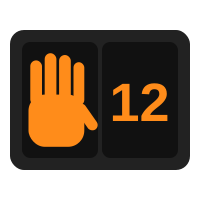
With a numeric countdown, a pedestrian may start crossing only if they can reach the other sidewalk before the steady orange hand appears (s. 444).
Fines and points
- Not stopping for a pedestrian at a crosswalk (s. 410), or not yielding on a green light or white walking figure (ss. 408 and 409): fine of $200 to $300 (s. 510).
- Not yielding to pedestrians and cyclists when turning at an intersection (s. 349): same fine and 2 demerit points (Regulation respecting demerit points, schedule, item 16).
- A pedestrian who breaks their own rules (ss. 444 to 453.2): $15 to $30 (s. 505).
Key points for the test
- A pedestrian waiting at the crosswalk or signalling already has the right of way: stop.
- When turning, yield to pedestrians and cyclists who are crossing.
- No passing through the opposite lane near a crosswalk.
- No stopping on the crosswalk or within 5 m of it.
Original questions with explanations and sources, “Highway Safety Code” section.
Practise for free
See also
Official sources
- Code de la sécurité routière (Highway Safety Code, CQLR c. C-24.2), ss. 3.1, 345, 349, 359, 386, 404, 408 to 410, 444, 446, 447, 450, 505 and 510
- Règlement sur les points d’inaptitude (Regulation respecting demerit points, CQLR c. C-24.2, r. 37), schedule, item 16
- SAAQ, Guide de la route (4th ed., 2024, French), ch. 1, “Une question d’attitude”; ch. 4, “Céder le passage” (“En présence de piétons”, “À un passage pour piétons”) and “Le piéton”
General information page, current as of 2026-10-28. If in doubt, the official text prevails. Rules can change: check saaq.gouv.qc.ca and legisquebec.gouv.qc.ca.