 Permis Prêt
Quebec road signs test with answers: signs to recognise (free)
Five road-sign questions with the answer, then 23 signs to recognise: shape, colour and meaning.
Reminder: on the exam, road signs are one of three parts, and you need 75% in each. To understand shapes and colours, also read Quebec road signs: shapes and colours.
Question 1 · Road signs and signals
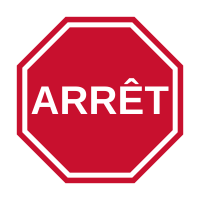
According to the Driver’s Handbook (Guide de la route), which sign is the octagon (8 sides) reserved for?
- A Yield
- B Stop
- C School zone
- D One way
Answer
Answer: B — Stop
The Guide de la route reserves the red octagon for the Stop sign, which requires a complete stop before yielding as needed.
Question 2 · Road signs and signals

What does a downward-pointing red and white triangle sign mean?
- A Mandatory stop
- B Yield
- C Danger: curve
- D End of speed limit
Answer
Answer: B — Yield
This inverted red and white triangle is reserved for the Yield sign: you must let vehicles on the road you are entering go first.
Question 3 · Road signs and signals
You reach a Yield sign and the main road is completely clear. What do you do?
- A You must make a complete stop
- B You proceed without stopping, ready to yield
- C You honk before proceeding
- D You wait for another driver to wave you on
Answer
Answer: B — You proceed without stopping, ready to yield
The Yield sign requires you to give way to vehicles on the other road. If the way is clear, you proceed without stopping; stop only if needed to yield.
Source: Code de la sécurité routière, art. 371 · Guide de la route, ch. 3, « Cédez le passage »
Question 4 · Road signs and signals
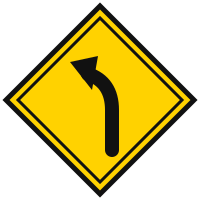
A yellow diamond-shaped sign generally indicates:
- A an obligation
- B a danger or a situation that calls for extra caution
- C a tourist service
- D road work
Answer
Answer: B — a danger or a situation that calls for extra caution
Yellow is the colour of danger (warning) signs, and the diamond is the shape of danger and work-zone signs. Work zones use orange.
Source: Guide de la route, ch. 3, « Formes et couleurs des principaux panneaux »
Question 5 · Road signs and signals
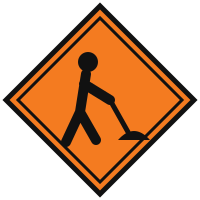
Which colour is reserved for road work signs?
- A Yellow
- B Orange
- C Green
- D Blue
Answer
Answer: B — Orange
Work-zone signs have an orange background. Advance work-zone signs announce a work area ahead: slow down and stay alert.
Signs to recognise
- Stop — Red octagon: complete stop required.
- Yield — Inverted red and white triangle: give way.
- Warning (curve) — Yellow diamond: hazard or extra caution.
- Road work — Orange diamond: work zone.
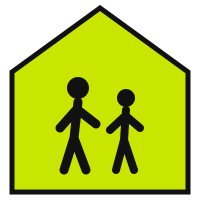 School zone — Yellow-green pentagon: start of a school zone.
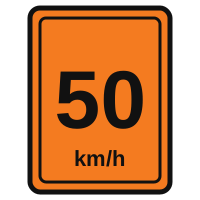 Work-zone speed limit — Orange sign: mandatory limit, doubled fine.
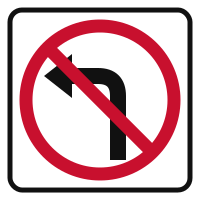 Prohibition — Red ring with bar: what is shown is prohibited.
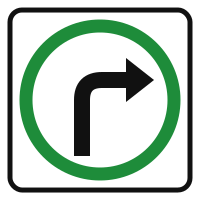 Obligation — Green ring: the manoeuvre shown is mandatory.
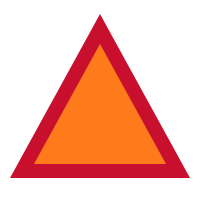 Slow-moving vehicle — Orange triangle, red border: vehicle built for under 40 km/h.
 Lane closed (red X) — Do not drive or stop in this lane.
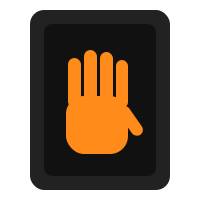 Orange hand (pedestrians) — Pedestrians must not start crossing.
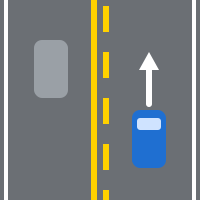 Mixed lines — Passing allowed only from the broken-line side.
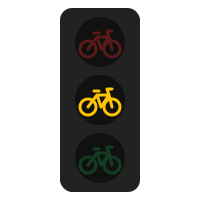 Cyclist signal — Red, yellow, green bicycles: same meaning as a regular light.
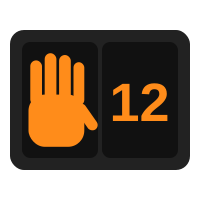 Pedestrian countdown — The number shows the time left to cross.
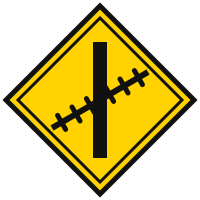 Railway crossing ahead — Yellow diamond: shows the angle of the track.
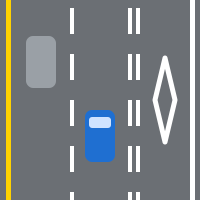 Reserved lane (markings) — Double broken lines: reserved at certain hours.
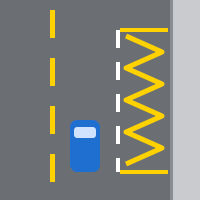 Bus stop zone — Yellow zigzag: no stopping your vehicle there.
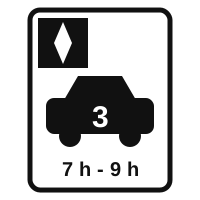 Carpool lane — Number on the car: minimum people on board.
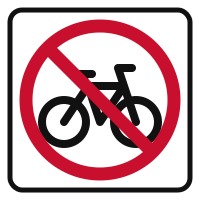 No bicycles — Bicycle in a red ring with bar: no access.
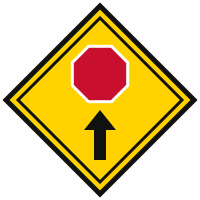 Stop sign ahead — Yellow diamond: a Stop sign is ahead.
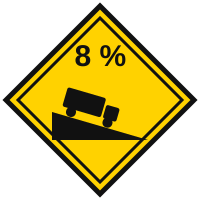 Steep grade — The percentage: metres of rise or drop per 100 m.
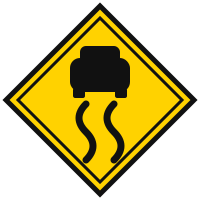 Slippery surface — Yellow diamond: slippery in places when wet.
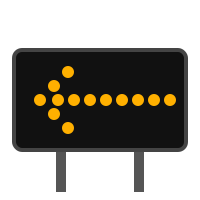 Signal arrow — Lane blocked: move to the lane shown.
The Road signs section of the app has 90 questions; 5 are free (the ones on this page) and the full version is a one-time CA$12.99.
Practise road signs Take the mock exam
Official sources
See also
- Quebec road signs: what do the shapes and colours mean?
- Learner’s licence in Quebec: what are the steps?
- Mandatory Class 5 driving course: how many hours, and who has to take it?
Practice questions from an independent product, current as of 2026-11-01. If in doubt, the official text prevails: check saaq.gouv.qc.ca.