 Permis Prêt
What are the speed limits in Québec?
The default limits in the Code, what overrides them, and what speeding costs.
Short answer: where no sign says otherwise, the limit is 100 km/h on an autoroute (with a 60 km/h minimum), 90 km/h on a paved road, 70 km/h on a gravel road and 50 km/h in a town or village. A posted speed limit sign always takes priority over these defaults.
Default limits
The Code de la sécurité routière (Highway Safety Code) sets these limits when no sign says otherwise (Code de la sécurité routière, s. 328):
| Type of road | Minimum | Maximum |
|---|---|---|
| Autoroute (freeway) | 60 km/h | 100 km/h |
| Concrete or asphalt road | — | 90 km/h |
| Gravel road | — | 70 km/h |
| Built-up area (town, village), except autoroutes | — | 50 km/h |
On a road leading into a built-up area, the 50 km/h limit starts where a sign shows it (s. 328).
When a sign changes the limit
- The Minister of Transport can change these limits; the installed sign is what counts, and you may not exceed it (s. 329).
- On autoroutes, variable message signs can set other minimums or maximums depending on weather or time of day (s. 328).
- In a school zone during the school period, the limit must be 50 km/h or less (s. 329.1).
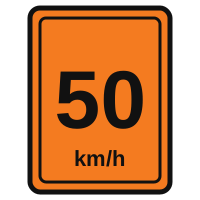
- In a work zone, the limit on the construction signs is mandatory, and the fine for speeding there is doubled (ss. 303.2 and 516).
The posted limit is not always the right speed
In darkness, fog, rain or snow, or on a slippery or partly cleared road, you must slow down even below the limit (s. 330). Driving too fast for conditions carries 2 demerit points (Règlement sur les points d’inaptitude, the demerit points regulation, schedule, item 8). The SAAQ handbook also reminds drivers that going so slowly that you hold up normal traffic is not allowed (Guide de la route, ch. 4).
Speeding: demerit points
| Over the limit by | Points |
|---|---|
| 11–20 km/h | 1 |
| 21–30 km/h | 2 |
| 31–45 km/h | 3 |
| 46–60 km/h | 5 |
| 61–80 km/h | 7 |
| 81–100 km/h | 9 |
Source: Règlement sur les points d’inaptitude, schedule, item 6. Beyond that, and for the excessive speeding cases below, the points are higher (items 6.1 to 6.3). Remember: a learner or probationary driver loses the licence at 4 points.
Excessive speeding
A police officer suspends the licence on the spot for 7 days in these cases (Code de la sécurité routière, s. 328.1):
- where the limit is 60 km/h or less: going 40 km/h or more over it;
- where the limit is above 60 and up to 90 km/h: going 50 km/h or more over it;
- where the limit is 100 km/h or more: going 60 km/h or more over it.
The suspension is longer for a repeat within 10 years, and the fine is doubled (s. 516.1).
Key points for the test
- Autoroute: 60 minimum, 100 maximum.
- Paved road 90, gravel 70, built-up area 50.
- The sign wins; bad conditions can call for less.
- Work zone: doubled fine.
Original questions with explanations and sources, “Highway Safety Code” section.
Practise for free
See also
Official sources
- Code de la sécurité routière (Highway Safety Code, CQLR c. C-24.2), ss. 303.2, 328, 328.1, 329, 329.1, 330, 516 and 516.1
- Règlement sur les points d’inaptitude (Regulation respecting demerit points, CQLR c. C-24.2, r. 37), schedule, items 6 to 6.3 and 8
- SAAQ, Guide de la route (driver’s handbook, French 4th ed., 2024), ch. 4, “Limites de vitesse et distance entre les véhicules”
General information page, current as of 2026-10-28. If in doubt, the official text prevails. Rules can change: check saaq.gouv.qc.ca and legisquebec.gouv.qc.ca.